Jordan Bohall
Hello! I’m Jordan, and I am an organic farmer and a barefoot farrier.
At Birdie & The Bees Farm, I practice small-scale, regenerative agriculture rooted in ecological balance and animal welfare. The farm produces Certified Naturally Grown vegetables, pastured chicken eggs, pork, turkey, raw honey, and vermicompost. I manage the farm with the goal of building soil health, biodiversity, and sustainable systems that endure without chemical inputs. Every enterprise on the farm functions as part of a living cycle: the animals enrich the soil, the soil nourishes the crops, and the entire ecosystem thrives in mutual support. This approach reflects a belief that resilience begins with respecting natural processes rather than controlling them.
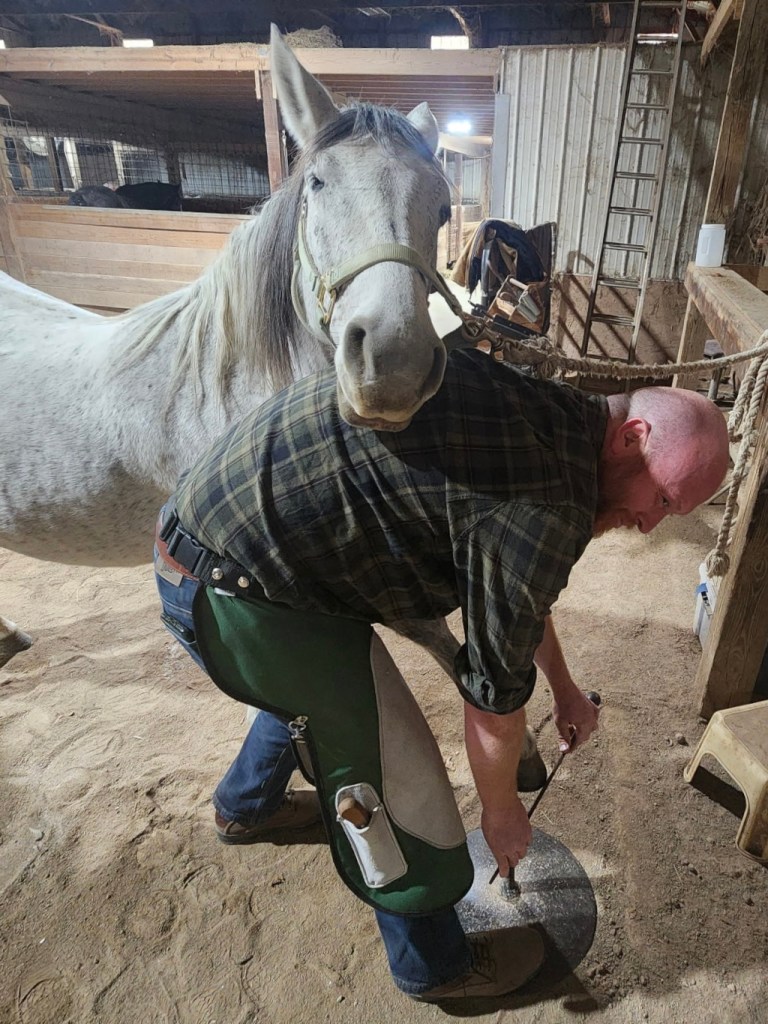
That same philosophy extends to my work with equines, goats, and pigs through Bloomington Barefoot Farriers. I learned Barefoot Trimming and hoof care at the Troy Price Horseshoeing School in Northern Indiana, which has allowed me to achieve my goals of promoting long-term soundness and comfort for animals by aligning hoof care with natural biomechanics, circulation, and balance. Years of farming have deepened my respect for how environment, nutrition, and movement shape health, and in hoof care and trimming, those same principles guide each trim and evaluation.
Why Barefoot Trimming?
Barefoot equine hoof trimming is a methodical, evidence-based approach to maintaining and restoring the natural structure and function of a horse’s hoof. It removes the reliance on metal shoes and instead supports the horse’s anatomy as nature intended—allowing the hoof to flex, expand, and interact with the ground in a way that promotes circulation, balance, and long-term soundness. This practice is not simply the absence of horseshoes; it is an intentional and informed discipline grounded in equine biomechanics, environmental management, and careful observation of each horse’s individual needs.
At its foundation, barefoot trimming recognizes that a horse’s hoof is a living, dynamic structure designed to support weight, absorb shock, and provide traction. In a natural setting, wild or feral horses travel many miles per day across varied terrain, wearing their hooves evenly and keeping them strong through constant movement. Domesticated horses, by contrast, often live in environments and routines that do not replicate this natural wear pattern. As a result, hooves can grow unevenly, distort, or become imbalanced—leading to strain on tendons, joints, and connective tissues. Barefoot trimming seeks to correct and prevent these imbalances by carefully shaping the hoof so that it functions as nature intended.

Central to barefoot trimming is the concept of function over form. While traditional shoeing often focuses on mechanical protection and external support, barefoot trimming relies on the hoof’s innate ability to strengthen itself through correct structure and stimulus. The hoof wall, sole, frog, and digital cushion work as an integrated system. When the hoof can flex with each step, it acts as a natural shock absorber and pump circulating blood through the lower limb and promoting tissue health. Metal shoes, while sometimes necessary for therapeutic reasons, can restrict this natural movement. By removing the shoe and maintaining proper balance through barefoot trimming, the horse’s body regains this natural efficiency.
From a biomechanical perspective, barefoot trimming supports efficient movement and load distribution. When the hoof lands flat or slightly heel-first, shock is absorbed through the natural flexion of the heel and frog. This movement dissipates force evenly up the limb, reducing strain on tendons and joints. Conversely, a long-toe or underrun-heel conformation can lead to delayed breakover, excess leverage on the toe, and eventual lameness. Correct barefoot trimming addresses these issues at their source, restoring the natural mechanics of movement and encouraging self-maintenance through proper hoof wear.
Ultimately, barefoot equine hoof trimming is about partnership between horse, human, and environment. It is a method rooted in respect for the horse’s natural design and adaptability. By removing artificial constraints and focusing on form that follows function, barefoot trimming restores the foundation of equine health from the ground up. A well-trimmed barefoot hoof is strong, resilient, and self-maintaining. It supports movement that is efficient, balanced, and pain-free, allowing the horse to perform, play, and live comfortably in alignment with its natural physiology.
 Bloomington Barefoot Farriers